25 eSIM Facts Every Traveller Should Know
Compatibility data, real cost comparisons, security features, and everything else about eSIM technology – the facts that help you travel smarter.
eSIM stands for embedded SIM – it\'s built permanently into your device
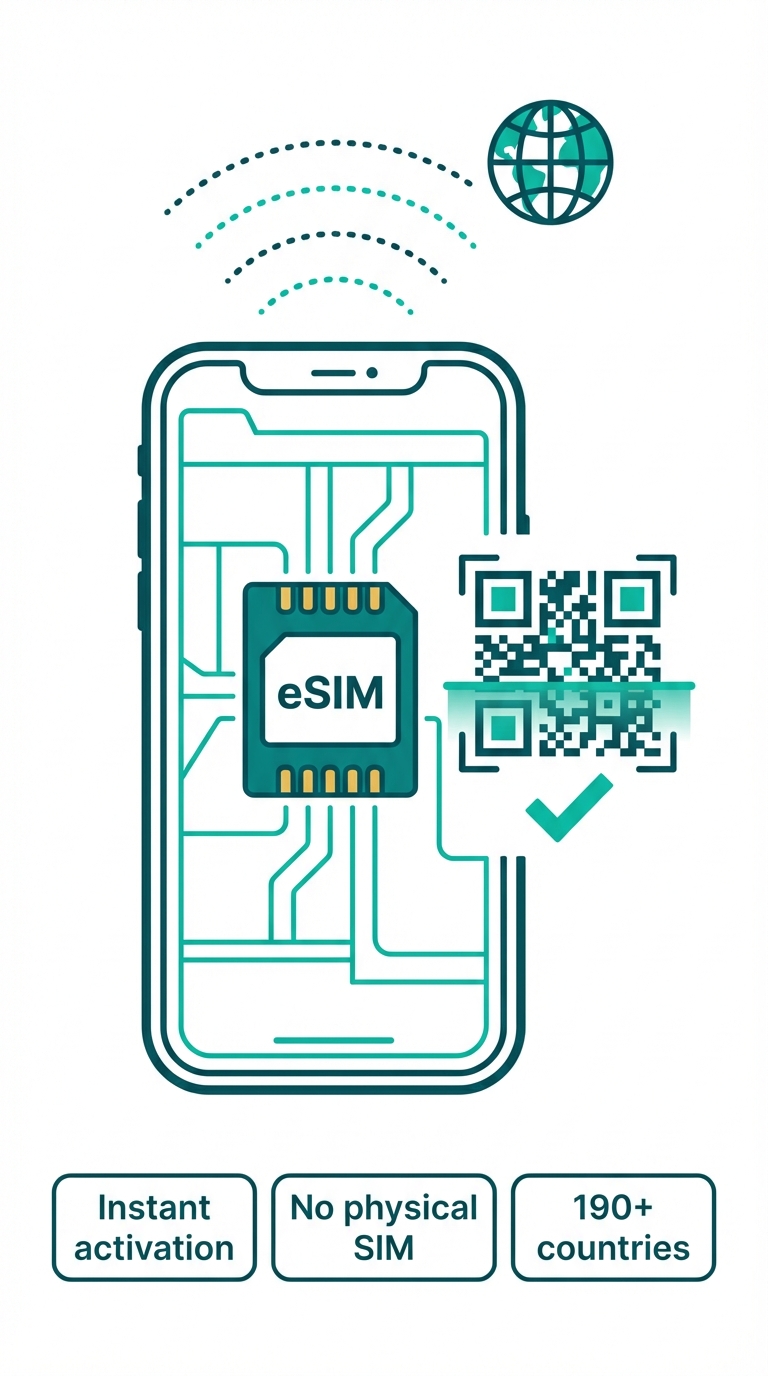
An eSIM is a tiny chip built into your phone’s motherboard. Unlike a physical SIM, it can’t be taken out, dropped or misplaced. Carrier profiles are stored digitally and can be rewritten over the air, much like updating an app.
What is an eSIM? →The GSMA created the eSIM standard, which reached consumer devices in 2016
The GSMA — the same organisation that sets global mobile standards — developed the eSIM specification. Consumer eSIM first appeared in the Apple Watch Series 3 in 2017, then in smartphones from 2018.
eSIM has been supported on iPhones since the XS and XR (2018)
Apple led the industry by being the first major phone maker to include eSIM. Every iPhone from the XS and XR onwards works with eSIM, and you can have two eSIM profiles active at the same time. The US model of the iPhone 14 went a step further — it did away with the physical SIM tray completely.
US iPhone 14 models have no physical SIM slot — eSIM only
Apple's boldest eSIM decision: the iPhone 14, 14 Plus, 14 Pro, and 14 Pro Max sold in the United States have no SIM card slot at all. Every connection runs through eSIM. Models sold internationally still keep a physical SIM slot.
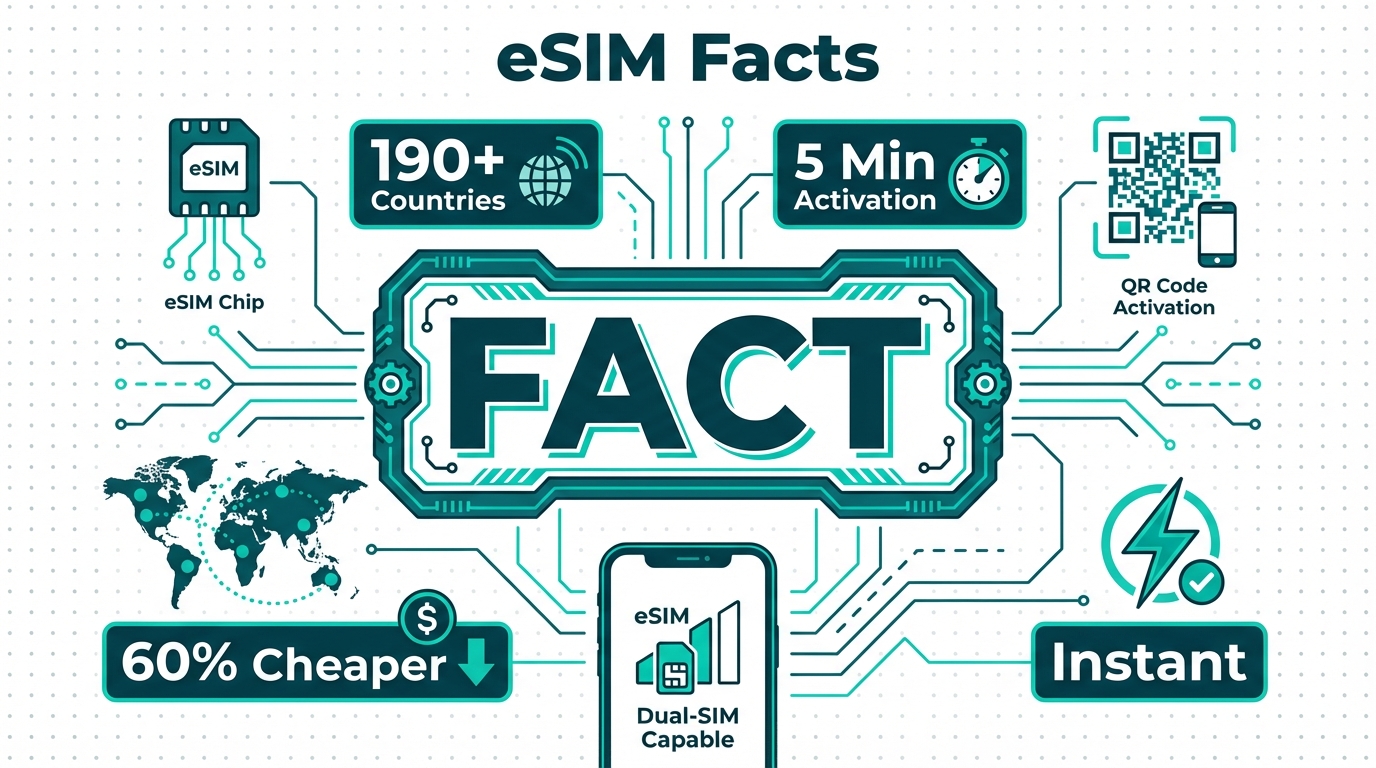
Activating an eSIM takes less than 5 minutes by scanning a QR code
After you buy an eSIM plan, you get a QR code. Go to your phone's Settings, tap "Add eSIM", scan the code, and you're connected. Most " ~ brand_name ~ " plans activate in under 3 minutes with no app needed. Compare that with hunting for a local SIM shop, queuing, and showing your ID.
eSIM plans cost 40–60% less than buying a SIM at the airport
Airport SIM cards come with a location premium — you're paying for convenience and captive audience pricing. eSIM plans bought online have no retail markup, no physical distribution costs, and no airport rent. A 5 GB plan for Japan bought at Narita costs S$35–50. The same plan on TPG Mobile: S$12–18.
Browse eSIM plans →You can keep up to 20+ eSIM profiles on one iPhone (iOS 17+)
Each eSIM profile is a separate carrier plan stored digitally on your phone. You can collect plans for different countries and switch between them without downloading anything new. Older iPhones store at least 8 eSIM profiles at once.
eSIM lets you run two lines — keep your home number active while using travel data
With eSIM plus your physical SIM, your home number still works for calls and texts (handy for two-factor authentication and work contacts) while the eSIM gives you affordable local data. No need to tell everyone “I’m on a different number while travelling”.
eSIM dual SIM setup →More than 190 countries now have at least one carrier that supports eSIM
eSIM coverage has grown fast. In 2019, fewer than 50 countries offered consumer eSIM. By 2024, 190+ countries have compatible carriers.TPG MobileeSIM plans give you access to 150+ countries through carefully chosen local network partners.
By 2024, more than 90% of new flagship Android phones come with eSIM support.
Samsung Galaxy S series, Google Pixel, Sony Xperia, OnePlus, and most flagship Android devices now ship with eSIM. Mid-range Android models are rapidly catching up. Budget and entry-level Android phones are the main exception — always check your device before buying an eSIM plan.
Check device compatibility →Google Pixel phones have supported eSIM since the Pixel 2, launched in 2017.
Google adopted eSIM early, alongside Apple. Every Pixel from the Pixel 2 onwards supports eSIM. The Pixel 7a and newer models also support dual eSIM — two active eSIM profiles with no physical SIM needed.
Samsung Galaxy S series has supported eSIM since the Galaxy S20 in 2020.
Samsung introduced eSIM across the Galaxy S20 range in 2020 and has included it in every flagship S-series model since. The Galaxy Z Fold and Z Flip series also support eSIM. Older Samsung models (S10 and earlier) typically do not.
An eSIM cannot be physically stolen from your phone.
A physical SIM can be removed by a thief or used in a SIM-swap attack. An eSIM is embedded inside the phone with no accessible slot. This removes one physical security risk. Carrier credentials live inside a secure eUICC (embedded Universal Integrated Circuit Card) chip.
You can remotely remove an eSIM profile if your phone is lost or stolen.
eSIM profiles are linked to carrier accounts, not the physical chip. If your phone is lost, contact your eSIM provider and they can deactivate the profile remotely. This is not possible with a physical SIM, which will simply work in any compatible device.
eSIM QR codes are single-use — scanning them a second time may fail.
Every QR code sent for eSIM activation works only once. After you scan and confirm it, the code is used up. If you need to reload the profile later (for instance, after a factory reset), you must ask your provider for a fresh QR code. Save a screenshot before you scan it.
You can buy and set up an eSIM plan while flying, using the plane's Wi-Fi
Because setup is fully digital, you can purchase a TPG Mobile eSIM plan mid-flight and have it working before you land. Connect to inflight Wi-Fi, make your purchase, scan the QR code, and your eSIM is ready — it will connect to local networks the moment you touch down.
Browse eSIM plans →eSIM data plans support voice calls over Wi-Fi calling
Most travel eSIM plans are data-only — no local phone number included. But with Wi-Fi calling enabled (built into iPhone and most Android phones), you can call and receive calls using your home number over the eSIM's data connection. No extra voice add-on required.
eSIM profiles live in a certified eUICC chip — the same security standard as a physical SIM
The eUICC (embedded Universal Integrated Circuit Card) stores eSIM profiles with the same ETSI and 3GPP security approvals as a regular SIM card. Your carrier credentials are kept in tamper-proof hardware, not exposed in the device's general storage.
A 1 GB eSIM plan for Japan usually runs S$4–8, compared to S$15–25/day in roaming
International roaming charges from major carriers are among the worst value in mobile data. A week in Japan on roaming could cost S$100+. A dedicated eSIM plan for the same trip: S$10–20. For frequent travellers, eSIM savings easily pay for the cost several times over.
Explore eSIM plans →eSIM works fine with a VPN — they operate on separate network layers
Your eSIM supplies the cellular data connection (Layer 2/3). A VPN app encrypts the traffic that travels over it (Layer 4+). They don't clash — in fact, combining a TPG Mobile eSIM with a VPN is the recommended approach for travellers who need both fast local data and private, unrestricted browsing.
Set up eSIM + VPN →The number of eSIM-ready device models rose from under 100 in 2019 to more than 1,000 in 2024
eSIM adoption has sped up considerably. What started as a feature for premium devices has quickly spread to mid-range models. Smartwatches, tablets, laptops, and even some IoT devices now support eSIM, greatly widening the range of options.
Most prepaid eSIM plans cut off automatically when you run out of data — no unexpected charges
Unlike roaming, where usage can quietly pile up charges until you notice, prepaid eSIM plans have a hard cap. When your 5 GB is used up, the plan stops — or tells you to top up. You stay in control of what you spend.
Data plans reset at midnight local time or when you activate — confirm yours
Daily eSIM plans (e.g., unlimited data per day) reset at midnight local time. Validity-period plans (e.g., 10 GB for 30 days) run from the moment of first use or from activation. Always check the plan details — TPG Mobile shows this clearly at checkout.
Some carriers let you move your eSIM to a new phone — keeping your plan alive when you upgrade
If you upgrade your phone mid-trip, most major eSIM providers allow profile transfer. The process varies: some use QR re-issue, others use device-to-device transfer. Apple's eSIM Quick Transfer lets you move profiles between iPhones wirelessly. Contact your provider before wiping your old device.
Transfer eSIM to new phone →TPG Mobile eSIM plans cover 150+ countries at local network rates
Rather than roaming agreements that route your data internationally, TPG Mobile uses local network partnerships in each country. Your data travels on local infrastructure — lower latency, faster speeds, and prices that reflect actual local data costs rather than international markup.
Browse eSIM plans →