What Is an eUICC and How Is It Different From an eSIM
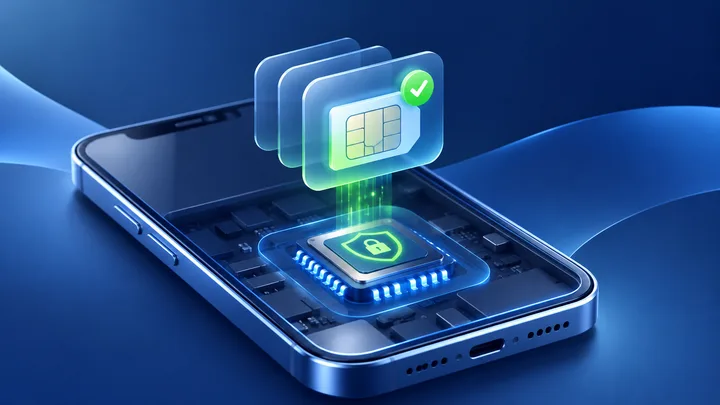
An eUICC is the secure place that can hold and manage carrier profiles. eSIM is the wider name people use for the digital SIM system and service built around it.
Key points
- An eUICC is a safe UICC that can manage carrier profiles.
- eSIM is a wider term for remote SIM service, the supporting device, and often the digital plan users see.
- The letter e came from embedded, but an eUICC can be removable or fixed inside a device.
- An EID names the eUICC. An ICCID names a carrier profile, so the two numbers do different jobs.
The words eSIM and eUICC often look like the same thing. In normal phone talk, that shortcut is often fine. It gets hard when support asks for an EID. It can also get hard when a profile will not load.
A simple layer map clears it up. The eUICC is the secure holder. A carrier profile goes inside it. The eSIM system lets that profile arrive and be managed without swapping a normal plastic card.
Start with the short answer
The GSMA says an eUICC is a UICC that manages profiles in a safe way. A profile has the carrier data a device needs to use a mobile plan.
The GSMA uses eSIM as a wide label. It covers devices and eUICCs that can get a SIM profile from afar. Phone makers also use eSIM as a simple name for a digital SIM or mobile plan.
So an eUICC is one working part of eSIM. It is not a data plan, phone number, QR code, or mobile network.
Place each part on a five-layer map
| Layer | What it is | Everyday clue |
|---|---|---|
| Phone or watch | The device using mobile service | It has an IMEI |
| eUICC | The secure profile holder | It has an EID |
| Carrier profile | Subscription data loaded into the eUICC | It has an ICCID |
| Mobile plan | The allowance, validity, and service rules | It appears in the provider account |
| Network | The radio service the device joins | A carrier name or signal appears |
A failure at one layer does not prove the other layers are broken. A phone can support eUICC but have no downloaded profile. A profile can be present after its data plan expires.
Do not let the word embedded mislead you
The name eUICC came from “embedded UICC.” It is easy to think each eUICC must be fixed to the phone's board.
That is not the full rule. The GSMA says an eUICC can come out or stay fixed in place. Its key job is to manage profiles in a safe way. It also supports remote SIM setup.
Most phone users still meet it as a built-in part. The wider rule matters for phones, smart cards, and new device designs.
Follow one profile through the eUICC
A provider makes a carrier profile. The phone's profile helper gets it through the eSIM system. The eUICC checks it and keeps it in a safe space.
When that profile is on, the phone can use it to join a network. Other saved profiles may stay off. Each device sets how many it can store or use at once.
A QR code is only one way to start this job. It is not the profile itself. It is not the eUICC.
Use EID and ICCID for the right objects
The EID names the eUICC. The GSMA says it is a global serial number for that part. It does not name a mobile plan.
The ICCID names a profile in the eUICC. A phone with many profiles may show many ICCIDs. The eUICC still has its own EID.
The phone's IMEI is different again. It names the mobile device. Support may ask for more than one ID since each points to a new layer.
See what deletion does and does not remove
Deleting an eSIM in the phone menu normally means deleting a carrier profile. It does not remove the eUICC hardware.
It also does not always cancel the plan or close the provider account. Those are provider actions. A one-use download code may not work again after deletion.
TPG Mobile says its QR code can be used once and the installed profile is locked to that device. Contact support before deleting a working TPG Mobile profile.
Use the distinction when choosing travel data
First check that the phone has eSIM support and is unlocked. That proves the device has the needed path. It does not prove a certain plan covers the trip.
Then match the service layer. Choose from TPG Mobile destination travel eSIM plans for a single stop. Use TPG Mobile border-crossing eSIM plans when the listed countries match a route.
For a long trip, check the full place list under TPG Mobile broad eSIM coverage. The eUICC can store the profile, but the plan still controls data, days, and covered places.
Describe a fault by its layer
- “The phone has no EID” points to device or eUICC support.
- “The download code is rejected” points to activation or provider checks.
- “The profile is installed but off” points to profile state.
- “The profile is on but has no data” points to the plan, network, data-line choice, roaming, or APN.
- “The plan expired but the profile remains” separates account state from stored profile state.
This wording gives support more useful facts. Saying “the eSIM is broken” can hide five very different problems.
Use a plain-language test for each term
Ask “Can the phone securely hold downloadable carrier profiles?” That question is about the eUICC.
Ask “Can I add and manage a digital mobile plan without swapping a normal SIM card?” That is the consumer eSIM question.
Ask “What data, days, countries, calls, or texts do I get?” That is about the plan. Keeping these questions apart makes setup and buying much easier.
Sources checked
These primary and official sources were checked before this article was written.
What an eUICC Is and How It Differs From an eSIM
An eUICC is the secure part that stores and manages carrier profiles. It has an EID and may be fixed or removable.
eSIM is the wider remote-provisioning system and the everyday name for a digital SIM service. A profile, plan, and QR code all take part, but none of them alone is the eUICC.